A movie I really wanted to like, Sam Raimi's Oz The Great and Powerful was rather disappointing and now I (as you will, soon) partially know why.
The original Evil Dead trilogy ended with 1992's Army of Darkness; which took the camp level up another 10 notches by making Ash (Bruce Campbell) a genius among idiots while forever cementing his status as a cult icon. And while I am a devout Raimi fan (hell, I love The Quick and the Dead), I must admit that Army of Darkness is my least favorite of the three. Unlike Evil Dead II's perfect blend of horror and slapstick, the third movie just tries a little bit too hard, if you know what I mean. Oh, don't get me wrong; it's hilarious and bizarre and horrific and evokes so many other genre films of the past, but of all of Raimi's earlier films, it is the most self-aware and consequently the least effective.
Regular readers know how much I adored Raimi's 2009 return to Horror, Drag Me to Hell. And while I was truly looking forward to seeing Raimi's visual stamp on the Oz franchise, I was truly disappointed to see the horribly over-produced mess that was Oz: The Great and... No, Not Really So 'Great,' More Like... 'Okay,' I Suppose.
Thankfully, the video embedded below helps explain at least part of what was wrong with the director's latest effort.
I somehow lost the link to the site where I found this. If you saw it somewhere else first, please let me know where. And please join me in hoping Raimi sticks to Horror from now on.
That's not quite right. My brain doesn't hurt (well, no one's does, but that's a question for a biology blog) but it is a bit frazzely. The day job is fine - good, even. The holidays are under control though I'm really looking forward to 10 days off in a few weeks.
The only news story that caught my eye was out of the Midwest and I commented on the JTMF Facebook page. I decided to take a night to attend to some of my long-neglected personal writing.
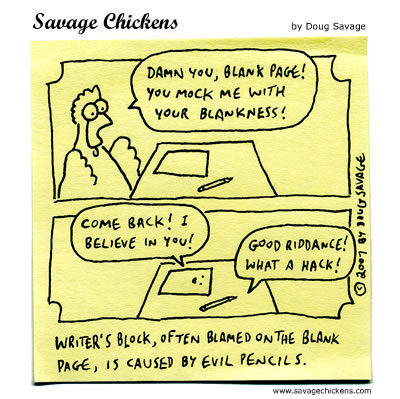
I hate leaving so much blank space on the page. It makes me feel like I'm being cheating myself (and wasting your time on such a nothing post). But the truth is, neglecting my personal writing is cheating myself and the world doesn't revolve around me. Unless I say so, and tonight it does.
Here's some pure, unadulterated idiocy and nonsense to make you laugh (or not - how should I know, anyway?). Okay. Love you. Bye.
The first time I saw that sketch, I nearly wet myself laughing.
Man, I miss 'Calvin and Hobbes.' It always made me wonder how Bill Waterston was able to access by childhood.
Any-who... I've decided to take a night to work on that damned screenplay and try and to figure out an Act III that makes sense and wraps the whole thing up. I've already dumped two attempts. Of course, I keep having dreams that have potential of becoming screenplays that are totally unrelated to the one I'm trying to finish.
All this, of course, while directing and acting in a new show.
All hell is breaking loose in the very scary place that is my mind. Let's just hope that translates to the page.
That's the hedge at the bottom of my driveway this past February. It will probably look very much the same tomorrow, despite what a co-worker who has a degree in meteorology told us on Thursday when we left for the holiday break. What makes it okay is that I have off tomorrow, anyway. And it makes my neighborhood so pretty, especially at the houses with holiday lights. I know many of you don't have off, but you may get to extend your holiday weekend anyway. It's a pretty epic storm, I guess. The NFL actually re-scheduled the Eagles' game tonight. It's the first time the NFL has postponed a game because of snow since the 30's (sometimes I 'm just so butch I almost can't stand it).
And yes, in case you're wondering, I got several pages of the screenplay written last night and think I've pretty much outlined the rest of the plot in full. After this brief post, I'm off to rewrite a scene so it supports the new outline. I'll probably spend a good portion of my snowed-in day writing, as well. The snow here won't stick around long - they're predicting temps in the 50's for next weekend.
I hope all my East Coast readers get a snow day tomorrow! I hope you're all snug and warm, watching the movies or playing the video games you got for Christmas or Hanukkah. I hope you have enough milk, eggs, bread and batteries to see you through the dig-out (is there some French toast rule I don't know about?). I hope some kids offer to shovel for $10 or $20, so you don't have to (so worth it). Even better, I hope a kind neighbor with a snow-blower digs you out for free (though you should at least offer a cup of cocoa). I hope you got a sled for Christmas! I hope you have a place to use it on your snow day! I hope you're careful! Wear a helmet! You'll shoot your eye out! Wait... wut?
If you're unlucky enough to have to go back to work tomorrow, I hope it's an easy and quick week for you.
I don't know when my zombie fascination started. Probably with George Romero's 1978 masterpiece, Dawn of the Dead. The nightmares didn't start until much later, though.
The first one I remember distinctly was incorporated into my screenplay Army of the Dead, though I had the dream at least 10 years before I even started writing screenplays. Of course, the screenplay I am working on now was almost entirely inspired by a zombie nightmare.
And last night, after watching the season finale of "The Walking Dead," I had a doozy, in which Uncle P's own mother was a cheek-less zombie, though she wasn't fully aware that she was a zombie. She kept asking, "I'm supposed to eat people? No, that can't be right." The dream eventually got silly, involving a castle about to be flooded to destruction, Dear D and a Katy Perry zombie that just couldn't be put down, even after her head had been bashed to bits with a chrome tire-iron...
Of course, much of that can be directly related to "TS-19," but most of it was just completely off the wall, as most of my dreams (nightmares or not) are. Occasionally, a dream or nightmare is so vivid it ends up being a full screenplay, as with Comatose Joe and my current project, though usually only certain elements make their way into my writing, as in Chimera and The Cow Says: Moo! More often than not, my dreams are so bizarre, they defy interpretation. Case in point - I recently dreamt that I was part of a theatrical production which was reproduced by another race of beings in a dimension which vibrated on a different frequency than ours. And that's all I can tell you about it without you thinking I'm completely insane (which no doubt, many of you already think, anyway).
I keep a dream journal on my nightstand, and write down the significant details of dreams I think my have potential commercial value, but save the weirdest ones to share with friends and family (none of whom are surprised those dreams' weirdness). I suggest that you do as well. You have no idea when your subconscious might come up with a brilliant idea or two...
My friend and fellow blogger Sean at Just a Jeep Guy recently posted his comparison between the British miniseries "Dead Set" and AMC's "The Walking Dead." To be fair, I have not seen "Dead Set," so I can't comment on it objectively. I know its premise - Participants in the BBC version of the so-called 'reality' show "Big Brother" find themselves the only survivors of the Zombie Holocaust. It starred the BBC version's real host and was a massive hit across the pond. It was run on IFC in it's entirety on Halloween, but my provider doesn't carry IFC, so I have to wait for the DVD version.
That having been said, Sean then goes on to list to the things he finds 'wrong' in Frank Darabont's groundbreaking "The Walking Dead." Needless to say, Uncle P had to take his friend to task for being just a bit closed-minded when it comes to the "Rules" of zombie fiction.
Among his objections (in red) and my responses to them:
"Zombies don't eat animals so the horse and rat should still be alive and well." - In George Romero's original Night of the Living Dead, zombies are shown eating insects, which means they are not limited to dining on human flesh. And in my 2004 screenplay Army of the Dead, a character says he saw "a bunch of 'em take down a horse in Central Park."
"Zombies have heightened senses and so are attracted to noise and human smells which cannot be covered up by covering yourself in zombie blood and body parts." - Zombie's senses have never been really explored, except in 1985's Return of the Living Dead, written by Dan O'Bannon (Alien) and original Romero collaborator, John Russo. The only sense they express in that movie is pain, and they say (Romero's zombies had never spoken before) that eating brains eases the pain of being dead. This is also the movie that introduced the idea that zombies are primarily interested in brains. Before that, they were only interested in living flesh.
"Zombies, like these in TWD, do not have the ability to think and therefore would not use rocks to break windows. Also, they shouldn't have the ability to climb ladders or fences." - Romero first introduced the idea of a thinking zombie in 1985's Day of the Dead, in which the zombie Bub expresses rudimentary memory such as shaving, using a phone and saluting. And in Romero's 2005 movie Land of the Dead, the zombies figure out that the lights across lake mean people are present, so there is no reason they shouldn't be able to use tools or climb ladders.
"In the second episode, we are at least 5-6 weeks into the apocalypse - most cars would have dead batteries by now and that scene of Glen flying down the road leaving Atlanta? Not a single broken down/abandoned car, dead body on one side of the road while the other is jam packed?" - Car batteries don't die after a few weeks or a month. My mother uses her car once a month and the battery is just fine. As for the highway being jammed in only one direction? Of course people would be trying to leave a city overrun by ravenous zombies, rather than trying to get into it. See Stephen King's "The Stand," in which cars jam the outbound lanes of the Lincoln Tunnel as people desperately try to escape the 'Captain Trips' virus. This makes total sense to me.
"Who has sex in the woods with zombies lurking about just weeks after her/his husband/best friends dies? Even if they where having an affair before the zombies came? I think the guild (sic) in addition to fear, would kill my sex drive." - Who doesn't get the thrill of dangerous sex in the outdoors? Fear and lust are two very closely related emotions, and if (as I have intimated and suspected) Shane and Laurie had been carrying on an affair before the whole zombie thing went down, they would certainly continue it, especially if they both thought Rick was dead. Of course, Laurie's guilt does prompt her to remove the wedding band she wears on a chain. And their fevered, animalistic rutting is certainly consistent with people who have something they want to hide from others.
The point is, when it comes to fiction -- and especially genre fiction -- there are no hard and fast rules. Writers create their worlds according their own visions and specifications. Is anyone about to tell Anne Rice that vampires can't be religious or Stephanie Meyer that they don't sparkle ?(OK - bad example - vampires do NOT sparkle).
In Uncle P's 'zombie-verse,' zombies don't actually have senses, but are directed by chemical responses emitted by the bio-engineered virus that controls them. In every version of a fictional story, the actions of the characters are dictated by the parameters of the author's own reality, and there simply are no rules.
Sean, I know you're reading - and that you have read the mini-version of this I posted in your comments - but please know that I'm not faulting your logic, but rather trying to expand your thinking on what genre fiction should be. In the end, all good fiction (regardless of genre) should comment on the unchanging Human Condition, and I'd say "The Walking Dead" is doing a bang-up job of it, whether you agree with it's particular set of 'rules' or not.
And speaking of genre rules, here's an example of some extremely silly ones that work because the plot adheres to the parameters of the story's own reality. I give you the latest trailer for Tron: Legacy:
No, I won't say I am writing a great movie... But I am writing yet another one and it's been ages since I've worked on it, so that is what I am off to do tonight.
Since my Let Me In review was really written on Thursday, this quickie is the 'official' Friday post.
I'll be back tomorrow with a new post over The Zombie Zone and will start the last of my Shocktober Directors posts on Sunday. Tonight, I have to figure out how to transition from Act II to Act III. Wish me luck. In the meantime, enjoy this creepy little delight (via):
I've been directing for longer than many of my Top Girls actresses have been alive (a fact that is somewhat distressing in and of itself), but I have never before encountered a play that raises more questions than it answers. And, truth be told, Caryl Churchill really doesn't seem interested in answering any of the questions she raises in Top Girls, leaving them instead, up to her audiences to decide.
Of course, art is subjective and should inspire conversation and debate. The human condition may well be constant, but its motives, inspirations and afflictions are myriad. And therein lies the conundrum of Top Girls. Caryl Churchill may well leave the questions up to the audience to decide, but a director and cast must answer at least some of them to create a cohesive and meaningful production.
Pressed by my producer to come up with a Director's Note for this production's program in time to go to press, I found myself (for once), at sea. Regular readers know that Uncle P is rarely one at a lack for words when it comes to expressing my opinions. But my opinions on this particular play are so diverse, it was nigh on impossible to come up with only one page's worth of discussion. In the end, I decided to focus on Churchill's attention on the need for social responsibility and how those that are 'Top Girls' need to be aware of, and nurture those who are not.
Art is one of the few things that connects humans to one another. For all our differences, be they religious; political; sexual or ideological, we all share the need to be productive members of the society in which we live. How we arrive at achieving that goal may vary, but it is ultimately our artistic expressions that connect us to one another.
Of course, all this may very well be idealistic bullshit, in which case I should stop directing and just become a mindless sheep... or not.
Wow! This entire post now seems little more to me an exercise in semantic masturbation, than anything worth really saying. I wouldn't blame any of you if never read another word I wrote...
To make up for it, here's some gratutious violence:
While that was truly awful, I somehow feel so much better.
It's only Tuesday and it's already been that kind of week (you know what I'm talking about).
Rehearsals for Sordid Lives continue to be amazing (tonight's was particularly hilarious). The show opens in exactly one month - June 25th. My outrageously talented cast keep coming up with brilliant bits on their own, while instantly taking to my suggestions and improving upon them by making them uniquely theirs.
We will be shooting some rehearsal footage for the YouTube video this Thursday and recording our podcast. I'll hopefully be able to share those with you sometime next week.
Tonight, with nothing particularly interesting to say, I am off to work on my latest screenplay. I am stuck on Act II (Act I and Act III are rolling along, but finding the right way to transition between them has proven problematic, at best). Anyway - have a good Wednesday, everyone.
Few things make your Uncle P crazier than bad grammar. Now, I'm not talking about the occasional typo or misspelling. I never had a typing class in my life and I have been known to misspell and/or mistype on occasion. But the abuse of the English language (admittedly, the most ridiculously difficult language on the planet) just drives me to the brink of insanity (as if I weren't already close to it, as it is).
In particular, the misuse of several phrases makes me want to send everyone back to repeat the 5th Grade. This post's title is one of them. The phrase "I could care less" implies that one cares, at least a little bit. What people mean to say is "I could not (or couldn't) care less." I bring this up because I read a post tonight by a blogger whose opinions I generally respect and with whom I usually agree, in which said blogger actually typed the words "I could care less,' when he really meant the exact opposite. This is not only bad grammar, but lazy speech and (even worse) lazy writing. Is it any wonder the U.S. Education System is failing on almost every level?
And of course, the other phrase that makes me want to pull my hair out by the roots is : "a whole nother." Folks, I am pleased to inform you that there is NO SUCH WORD as "nother." It should be either "another whole" or "a whole other." I've heard national newscasters use this un-word on air, and it makes me want to smash my TV with a sledge hammer. This isn't rocket science, folks. It's basic English, supposedly (and don't get me started on people who say "supposably") taught to you when you were 10 years-old.
Almost as bad (at least in my book), is poor punctuation. In particular, the misuse of commas; colons; semi-colons and parentheses. As you have probably ascertained by now, even if you've only read one or two of my posts, I am quite fond of parenthetical sentences and phrases. But when I do use them, I make sure to punctuate them properly. A punctuation mark always goes after the closing parenthesis, unless the parenthetical sentence stands alone (which is rarely). And the semi-colon is probably the most misused punctuation mark; semi-colons should only be used when a new idea is presented as part of the same sentence or when writing lists in sentences in which commas have already been used. A comma should never be used before or after the the word "and" (as evidenced by the example just cited), and may be used before or after the word "but," at the writer's discretion. Apostrophes are used to denote contraction and possession: Leon's hos weren't bringing him the money they owed him, so he beat them until they gave him all of their johns' money. When the denotation of possession belongs to a plural group, the apostrophe always goes after the plural S.
You should be glad that I'm not about to go into the abuse of conjugational tenses, as that could lead to another three or four paragraphs which you won't read because you've already grown bored by this topic.
Confused? Who wouldn't be? Is there help? Of course. I highly suggest the purchase of The Elements of Style, by William Strunk, Jr. Written in in 1918, it is still the standard for use of grammar and punctuation when writing in English. Of course, language is fluid. Words and phrases come in and out of style with the regularity of hem-lengths. And of course, the rules of grammar vary from language to language. But in the English-speaking (and writing) world, grammar is a constant and those who ignore it, are doomed to be derided by pompous a-holes like me.
Okay. I feel better now. Another rant is over. If you are an English teacher or grammarian and have seen something in this post that is incorrect, by all means feel free to make a comment which derides my ignorance. Better you should correct me, than let me disperse misinformation. If you you are not an English teacher or grammarian, but you think I'm being an elitist a-hole (which I probably am), then feel free to call me on it. I'm a grown-up and can take whatever you dish out.
Back to my regularly scheduled nonsense, anon. Prospero